Basic Principles of Waste Incineration Power Generation
Waste undergoes three stages: drying, combustion, and burnout, burning fully at high temperatures of 850-1100°C. The DCS automatic control system and automatic combustion control system enable real-time monitoring and adjustment of the combustion conditions inside the furnace, regulating the grate speed and combustion air volume accordingly. The high-temperature flue gas produced by incineration exchanges heat in the waste heat boiler, generating superheated steam that drives the steam turbine generator set to produce electricity. This electricity is transmitted via the power grid to various locations, achieving resource recovery from waste treatment.
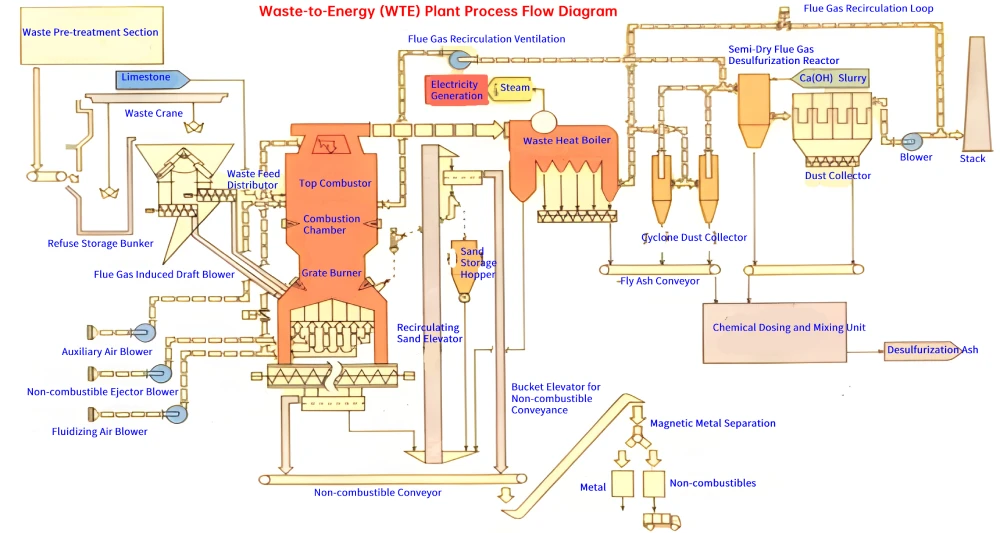
Waste is transported by trucks to the incineration plant, weighed on a scale, driven to the unloading gate, and dumped into the waste pit. A waste crane then feeds the waste into the hopper and subsequently into the furnace for combustion. The intake of the forced draft fan is connected to the waste pit, drawing in odorous gases and thermally decomposing them into odorless gases within the furnace operating at approximately 850–1100°C.
The combustion flames and high-temperature flue gas pass through a natural circulation boiler, generating high-temperature steam that provides the steam source for the turbine generator set.
The boiler and turbine generator set are centrally controlled and monitored from the central control room.
The resulting bottom ash falls into the slag removal system. After cooling, it is transported to brick factories for comprehensive utilization.
Fly ash collected by the pre-treatment electrostatic precipitator system is not classified as hazardous waste. After collection, it is transported to cement plants or mixing stations for comprehensive utilization.
Fly ash collected by the semi-dry flue gas purification system is classified as hazardous waste. It is conveyed to the solidification workshop, undergoes cement solidification and curing, and is then transported to a landfill for safe disposal.
Leachate is treated to meet discharge standards before release.
Treated flue gas, meeting environmental protection standards, is drawn by the induced draft fan and discharged through the chimney.
Essential Waste-to-Energy Knowledge
- What is Waste Incineration Treatment?
Incineration means burning away or destroying. During combustion, combustible materials are completely consumed, turning into ash. Incineration treatment utilizes high-temperature oxidation to process municipal solid waste (MSW) – burning the waste at high temperatures so that combustible components transform into carbon dioxide, water, etc. The resulting ash and slag constitute less than 20% of the original waste volume, significantly reducing solid waste quantity and eliminating various pathogens. - What is the Status of Waste Incineration Treatment Abroad?
- Europe: EU member states are increasingly adopting waste incineration. The EU’s highest waste management directive explicitly supports and encourages energy recovery (primarily incineration). From 1996 to 2007, landfill volumes decreased while incineration volumes rose. In 2006, 425 WtE plants treated about 63.62 million tons of MSW, a 20% increase from 2001.
- United States: Incineration has a consistent role in US waste management (~14% treatment rate). In 2007, 87 WtE plants processed 28.7 million tons of waste with a total capacity of 93,943 tons/day and generated 17 billion kWh of electricity. US capacity is roughly double that of China, concentrated in the economically developed Northeast.
- Japan: Incineration has long dominated waste treatment. For example, Tokyo’s central incinerator is only 3.5 km from the Imperial Palace, with 7 plants within a 7 km radius. Large-scale plant construction began in the 1960s, replacing older, smaller facilities. Despite a reduction in the number of plants due to stricter pollution controls and waste reduction efforts, incineration remains the primary treatment method.
- Singapore: Policy mandates “developing and maintaining sufficient incineration capacity to burn all burnable waste and sufficient landfill capacity for non-burnables and incineration ash.” Singapore employs full incineration with ash landfill. It has 4 WtE plants and 1 landfill (Semakau Landfill, expected to last until 2045). The Tuas South Incineration Plant, with a capacity of 3000 tons/day (world’s largest), generates 981 GWh annually, meeting 2-3% of Singapore’s electricity demand.
- What is the Current Status of Waste Incineration Power Generation in China?
China started later but developed rapidly. The first plant (Shenzhen Municipal Sanitation Comprehensive Treatment Plant, 3×150 tons/day, 4MW) was built in 1988. Subsequently, plants were established in Zhuhai, Shanghai (Pudong & Puxi), Ningbo, Hangzhou, Wenzhou, Suzhou, Changzhou, Chongqing, Chengdu, Guangzhou, Fuzhou, Xiamen, Tianjin, Beijing, and others. By 2010, over 170 WtE plants were built or under construction nationwide. - Can Municipal Solid Waste Burn? Can it be Incinerated Completely?
- Calorific Value: The heat released per unit mass (or volume) of fuel upon complete combustion. With rising living standards, the calorific value of Chinese MSW has increased to around 4200 kJ/kg (approx. 1/4 of coal). Modern mechanical grate furnaces can sustain combustion without auxiliary fuels (coal, oil, gas). The resulting slag is dense, sterile, and non-putrescible.
- What are the Benefits of Incineration? How Much Power per Ton? CO2 Reduction?
Incineration offers “reduction, resource recovery, and harmlessness.” It requires less land, rapidly stabilizes waste, significantly reduces volume, controls odors relatively easily, and utilizes waste heat for power/heat generation, aligning with circular economy principles. It’s a widely adopted international technology.- Power Generation: Typically 250-350 kW·h per ton of waste (grid supply).
- Resource Saving & CO2 Reduction: Saves 81-114 kg standard coal and reduces CO2 emissions by 202-283 kg per ton of waste incinerated.
- Which Cities are Suitable for Waste Incineration?
Rapid urbanization and population growth lead to a “garbage siege” crisis. Landfilling and composting are insufficient or have negative impacts (soil, land scarcity). Economically developed regions and cities, facing land constraints, are increasingly adopting incineration for its space-saving and harmless treatment benefits. Less developed areas with ample land may still rely on landfilling. - What are the Main Incineration Technologies?
Two mainstream technologies exist:- Mechanical Grate Furnace: Mature, long history. Handles raw waste without pre-treatment. High reliability, long operation time, large capacity. Requires no auxiliary fuel during stable operation, produces less fly ash. Predominant technology globally and recommended by Chinese policy.
- Circulating Fluidized Bed (CFB): Shorter application history in MSW. Requires pre-treatment (sorting, crushing) risking odor/leachate leaks. Needs coal addition (up to 30% by mass, crushed), consuming non-renewables. More suitable for RDF or sludge. Not the mainstream technology for raw MSW in China.
- How is Incineration Heat Energy Utilized?
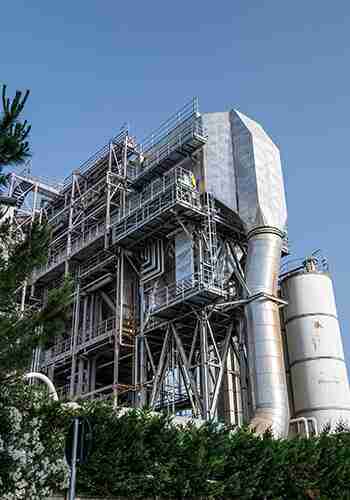
The heat from burning waste replaces fossil fuels (coal, gas, oil). Steam generated drives turbines for electricity generation, combined heat and power (CHP), or direct heating. This treats waste while conserving resources and supplementing power supply. - What Emissions are Produced? How are they Controlled?
WtE plants face stricter emission standards than coal/oil boilers. Flue gas contains pollutants like dust, HCl, SO₂, NOₓ, CO, HF, organics, dioxins, and heavy metals. Advanced automated control systems optimize combustion to minimize formation. Flue Gas Treatment (FGT) systems (e.g., lime injection, activated carbon adsorption, baghouse filters) clean the gas. Continuous Emission Monitoring Systems (CEMS) ensure compliance before discharge via the chimney. - What Residues are Produced? How are they Managed?
- Bottom Ash: Non-hazardous residue after combustion (glass, metals, inorganics). Classified as general solid waste. After magnetic separation (recovering metals), it’s widely used (e.g., road base, landfill cover, bricks). Utilization rate ~98%. Non-utilizable portions are landfilled.
- Fly Ash: Collected from FGT systems. Contains concentrated pollutants (dioxins, heavy metals). Classified as hazardous waste. Must be collected separately, stabilized/solidified (typically using chelating agents + cement + water), and disposed of in secure hazardous waste landfills after passing leaching tests. Transport requires specialized vehicles.
- What are Dioxins from Waste Incineration?
Dioxins refer to a group of 210 highly toxic, persistent, bioaccumulative compounds. They form during combustion processes. Significant sources include uncontrolled burning (open fires, landfill fires), metallurgy, coking, certain chemical processes, vehicle exhaust, and even cigarettes/forest fires. They are not unique to modern waste incineration. - Why are Dioxins in Incinerator Flue Gas?
Sources include:- Trace amounts present in incoming waste survive incineration.
- Formation from chlorine-containing precursors (e.g., PVC plastics, treated wood) during combustion (most destroyed at high temp).
- De novo synthesis from carbon, oxygen, hydrogen, and chlorine on fly ash particles catalyzed by metals (esp. copper) in the 300-500°C temperature range, especially under poor combustion conditions.
- Can Dioxin Formation be Controlled in Incineration?
Yes. Key measures:- Good Combustion (“3T+E”): Maintain furnace temperature >850°C, ensure sufficient gas Residence Time at this temperature (>2 seconds), promote strong Turbulence, and ensure adequate Excess Air. This destroys precursors and formed dioxins. Low CO levels indicate good combustion.
- Rapid Quenching: Quickly cool flue gas through the critical 500-300°C de novo synthesis temperature window to minimize reformation.
- Can Dioxin Emissions be Controlled?
Yes. Post-combustion control involves:- Adsorption: Injecting Activated Carbon (high surface area >700 m²/g) into the flue gas to adsorb dioxins.
- Filtration: Using highly efficient Baghouse Filters with specialized fabric. The dust cake layer (lime, activated carbon) further adsorbs dioxins. The collected fly ash (containing captured dioxins) is stabilized as hazardous waste.
- Do Waste Incineration Plants Smell? How is Odor Controlled?
Odors (primarily H₂S, NH₃) originate from decomposing organic waste in trucks and the waste pit. Control measures include:- Sealed Trucks: Use enclosed, automated vehicles for transport.
- Negative Pressure Pit: Maintain the waste pit under negative pressure using fans that draw air into the furnace (destroying odors via combustion).
- Sealed Building & Airlocks: Enclose the tipping hall and use air curtains at entrances. Keep tipping doors closed except during unloading.
- Leachate System Control: Enclose the leachate treatment system and vent gases back to the waste pit/furnace.
- Backup Air Treatment: Use activated carbon filters during plant shutdowns.
- Landscaping: Plant trees around the site as a buffer.